Tuesday, June 10, 2014

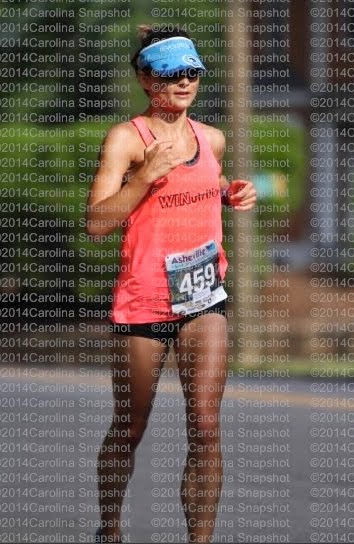
Race Report: Asheville Half Marathon


On Saturday I raced one of the toughest half marathon courses I've ever done.  I knew this race was going to be hilly when I signed up given that Asheville is basically in the Smokey Mountains, near the Blue Ridge Parkway and Appalachian Trail.  BUT, I got a little bit more than I had bargained for.
The city itself sits at 2,134 ft and I swear coming from sea level I could tell a difference in the "thin-ness" of the air!  The night before the race I took a quick look at the elevation profile of the course and was a little nervous to see that it had about 500 more feet of elevation gain than the Mistletoe Half Marathon, which is probably the last hilly half marathon that I've run (other than trail races):

Elevation Profile of the 2014 Asheville Half Marathon
In preparation for this race I didn't do any hill training because there are no hills here in Wilmington.  Yes, I could have gone downtown and run the bridges and yes, I could have run on the treadmill with an incline, but I did neither of those.  My preparation including sticking to my awesome training plan by coach Tom Clifford of Without Limits and cleaning up my diet to drop some body fat.  I averaged about 40-45 miles per week for a month leading into this race and consistently ran 13-15 miles on the weekends, plus a track workout each Wednesday night.  I also ate pretty much a fruitarian diet, sticking with fruits, veggies, some nuts & seeds, and soy milk.  I was able to lose about 5 pounds and about 3% body fat.  I felt really good eating this cleanly again and I found that I recovered really quickly from all my hard workouts!

Ok, so Saturday morning we were driving to the race start and talking about competition.  Just as I was telling Kurt that the website wouldn't have boasted "world class competition" and a $3000+ prize purse if there weren't going to be fast people there, Susan Jerotich of Kenya ran by with some of her fellow countrymen.  They looked ... really fast.
Susan Jerotich of Kenya
The last time I saw Susan and the rest of her pack was at the start of the race.  I lined up near the front and as soon as the gun went off the insanity started.  The first 1.5 miles were pretty much down hill.  I looked at my watch and I was running about 6:30 pace.  It was a tad fast, but I remembered a text that Tom had sent me that morning, "Remember, run the downhills...that's where you get fast in the mountains."  So I kept going at that pace and tried not to let myself break myself.  I was hoping that most of the people in front of me were doing the 10K, but at the split many of them turned onto the half marathon course.  Rats!

The first crazy hill hit at around mile 2.  It started going up and it just didn't stop.  And, it was steep.  I didn't dare look at my watch to see how slow I was running b/c it felt like I could have been going faster had I been crawling.  Finally, after a bunch of switchbacks, there was nice long downhill.  Well, actually it wasn't that nice because when you "run the downhills" they are actually tiring!

Miles 4-5.5 were relatively flat and I was hoping to gain some time here.  However I could tell my legs had taken a beating from that initial climb/downhill because they weren't springing back to full force.  In my mind I should have been running around 6:45 pace on that flat section, but in reality was actually running around 7:05 pace.  I didn't want to force myself to go faster b/c I knew there were more hard hills coming up.

Enter miles 5.5-7.  More crazy switchbacks into thinner air.  Around mile 8 or 9 there was a very long sustained climb.  I had a mile that clocked in at 7:45 pace.  I wasn't happy about this b/c it was a full minute off my desired goal pace.  But at that moment in time, it was just about putting one foot in front of the other and continuing to move forward (and upward).  I reached the summit of that hill and decided to tear down the backside of the hill, clocking the next mile in 6:27.

Hurting big time!
I knew the last 2 miles would be mostly uphill and mentally clicked into gear to push through the pain.  I remembered listening to Ironman World Champion Mirinda Carfrae speak at Revolution 3 Triathlon Quassy 70.3 a couple years ago after her win on a very hard course.  She said, "it's just pain."  With about 1-1.5 miles to go, I was delivered a little treat.  A carrot to be exact.  I was catching up to another woman!  This gave me a task to focus on for the last part of the race.  Within a half mile to the finish I barreled down a hill and noticed that I had gained significant time on her.  I kept using this strategy of running really hard down the hills, just hoping that my quads weren't going to give out!  This paid off because at the very last turn on the course, at the bottom of the very last hill I caught her!  There were only about 50 yards left in the race, all straight uphill.  I braced myself for an uphill sprint to the finish but when I passed her she didn't surge at all.  Fine by me.  I ran strongly up the finish chute (there was no way you could even think about walking this final hill b/c it was lined with spectators) to clutch 5th place overall for the women.

My total time was 1:34:25 (7:13/mile).  Not close to my PR (1:25:55) or to the goal pace I had in my head (6:45/mi), but still somewhat decent considering the difficulty of the course.  It was certainly a challenge and I was very happy to complete it!  I walked back to mile 11 where I met Kurt & ran with him to the finish.  It was amazing to see so many people tackling this course and refusing to give up!  Congrats to all finishers on a job well done!

Kurt & I spent the rest of the day indulging in the offerings of Asheville.  Yes, we basically ate and drank our way through the city.  We found some pretty cool micro breweries and even a place called The Chocolate Lounge where all they serve are desserts made out of chocolate.  YUM!  We didn't make it to the Biltmore, but hey I guess that gives us a good reason to come back next year and run this race again!  To quote the website, "If you're a runner, this is one to run!"

Glad to be done!


Monday, June 2, 2014

What the HELL is Nutritional Yeast!?


The food that I've selected for June Food of the Month is Nutritional Yeast!  I realize that many people have never heard of nutritional yeast and may be turned off by the name of it.  BUT, don't let that stop you from trying it!  

Nutritional yeast is inactive yeast that has been cultured in a mixture of sugarcane and molasses and then dried. The end result is tasty little yellow flakes, which are sold in health stores, such as Whole Foods, often in the bulk section. Nutritional yeast has a tangy nutty cheesy flavor and is super healthy. It contains a TON of B vitamins (is a great source of B12 for vegans) and has ~8g non-animal protein per tablespoon! In addition to it's nutritional benefits, I have a friend who swears that it prevents hangovers when eaten late-night after overindulging in alcoholic beverages! However, user beware! This stuff is so good that it is seriously addictive - another friend refers to it as "hippy crack!"

Here is a little list of great ways to use nutritional yeast!

1.  Popcorn.  Probably my favorite usage of nutritional yeast.  Sprinkle nutritional yeast on top of popcorn and I guarantee by the end of the bowl you will be licking it off your fingers :)  Even better (but a lot more unhealthy), take nutritional yeast with you into the movie theater - it tastes awesome on movie theater popcorn.

2.  Potatoes.  Add nutritional yeast to your mashed potatoes for added cheesy flavor.  Sometime I also sprinkle it on baked potatoes and sweet potatoes (this is a great substitution for butter or sour cream).

3.  Soups/stews.  Stir in some nutritional yeast as a savory flavor adder.  

4.  Kale chips.  Lightly mist raw kale with oil.  Sprinkle with Mrs. Dash & nutritional yeast & bake until crispy.  Yum!

5.  Pizza.  Sprinkle nutritional yeast on top of cheese-less pizza.

6.  Spaghetti.  Ditch the green can of processed Parmesan cheese.  Instead use a few sprinkles of nutritional yeast.  

7.  Vegan pesto.  Substitute nutritional yeast for Parmesan cheese in pesto recipes.  See below for one of the BEST vegan pesto recipes EVER!

8.  Vegan mac & cheese.  Nutritional yeast can be made into a cheese-less sauce, perfect for vegan version of kid's favorite meal!  There are tons of recipes

9.  Vegan nacho cheese dip.  Sounds weird, but tastes amazing.  See below for recipe!

10.  Grits.  Craving good old fashioned sausage & grits?  Simply cook some grits, add some Gimme Lean veggie sausage, a little unsweetened soy milk & vegan butter, + nutritional yeast and you will think you are eating the real thing!

11.  Roasted veggies.  Sprinkle on top of roasted veggies to add cheesiness. 

12.  Bread crumbs.  Use nutritional yeast in place of bread crumbs!

13.  Salad topper.  Sprinkle on top of salads to add flavor without all the added fat calories in typical salad dressings. 

14.  Vegan gravy.  Nutritional yeast provides a flavor boost to vegan gravies.  

15.  Dog food.  Yes, dog food.  One client told me that her dog would never eat it's food until she started adding nutritional yeast to it and now her dog can't get enough of the stuff!


Vegan Pesto
2 cups fresh packed basil
3/4 cup nutritional yeast
1/2 cup olive oil
2 cloves garlic
1/3 cup walnuts
salt & pepper to taste

1.  Blend all of the above in high-powered blender until consistency of pesto is reached.  
2.  Toss with whole wheat penne pasta.  


Nacho "Cheese" Dip, from The Everything Vegan Cookbook by Jolinda Hackett
3 Tbsp vegan margarine
1 cup unsweetened soy milk
3/4 tsp garlic powder
1/2 tsp salt
1/2 tsp onion powder
1 Tbsp peanut butter
1/4 cup flour
1/4 cup nutritional yeast
3/4 cup salsa
2 Tbsp chopped canned jalapeƱo peppers
[I also sometimes add in a little Cholula and Red Hot to add to the depth of flavor in this dip!]

1.  Heat margarine and soy milk together in a pan over low heat. Add garlic powder, salt, and onion powder, stirring to combine.  Add peanut butter and stir until melted. 
2.  Whisk in flour, 1 Tbsp at a time until smooth.  Heat until thickened, about 5-6 min.
3.  Stir in nutritional yeast, salsa, & jalapeƱos.  
4.  Allow to cool slightly before serving, as sauce will thicken as it cools.  


Monday, May 5, 2014

May Mango Madness


The Food of the Month for May is one of my favorite fruits - mangoes!  Mangoes are so delicious and are in season right now so it's likely you'll be able to find some really good deals on them in the grocery store right now.  (Buy a case at Whole Foods and receive a 10% discount).

How do you pick a good mango?
*Gently squeeze the mango; ripe mangoes have a slight give, similar to a ripe peach or avocado.
*As mangoes ripen, the skin turns from a green to a more golden hue.
*Ripening may be accelerated by placing the mango in a paper bag.
*Once ripe, mangoes may be stored in the refrigerator to prevent over-ripening.

How do you cut a mango?


Like all fruits, mangoes are super healthy for you.  One mango contains:

  • 124 calories
  • 1.7 g protein
  • <1 g fat
  • 31 g carbohydrates
  • 3.3 g fiber
  • 0 mg cholesterol
  • 23 mg calcium
  • 348 mg potassium
  • 2 mg sodium
  • 75 mg vitamin C
  • 89 mcg folate
  • 112 mcg vitamin A
Mangoes are also packed with phytonutrients called carotenoids.  Carotenoids are vitamin-A precursors that give foods their deep yellow/orange/red color.  They have anti-oxidant and protective effects in the body.  Some carotenoids found in mangos include:
  • beta-carotene - antioxidant & anti-cancer properties
  • lycopene - preventative against prostate cancer
  • cryptoxanthin - possible immune system booster
  • lutein - preventative against macular degeneration & cataracts
  • zeaxanthin - beneficial for eye health
Chopping, cooking, & pureeing caroteinoids increases bioavailabily (amount that is absorbed), so making smoothies out of frozen mangoes is an awesome way to eat this fruit.  Here is one of my favorite mango recipes from Dr.Fuhrman.com!

Mango Ice Cream (makes 2 servings)
2 cups frozen mango chunks
1 frozen banana
1/2 cup soy milk (or other non-dairy milk)
2-4 pitted medjool dates (optional)

Blend ingredients in high-powered blender until smooth.  Top with cinnamon if desired. 

Come in to TOPS Athletics this month for more yummy mango recipes!

Acai bowl from SurfBerry with delicious mango!

Note:  The best source of carotenoids is food.  Don't take high-dose supplements of carotenoids (or anything for that matter) because the body cannot regulate absorption as well and consuming too much can be dangerous.  For example, studies have shown that taking extremely high doses of carotenoids in supplement form increased risk of lung cancer in smokers.  

Saturday, April 26, 2014

What's Your VO2 Max?


If you’ve ever spent much time around endurance athletes then it’s highly likely you’ve heard the term VO2 max thrown around.  VO2 max is generally accepted as the best indicator of endurance capacity.  Technically, it is the maximal amount of oxygen one can use during intense exercise.  Having a high VO2 max is a prerequisite for reaching a high level of competition in endurance sports.  It “punches your ticket.”  

VO2 max and the amount that you can increase your VO2 max are largely genetic.  Training can increase VO2 max by 15-20% in a sedentary person, but the more highly trained you are, the less you will be able to increase your VO2 max (because you are already close to your genetic potential).  Improvements in VO2 max through training are due to increases in the size & number of muscle mitochondria, greater cardiac output per heartbeat, and increased capillarization to the muscles.  

I’ve always wanted to do a VO2 max to find out what mine is.  Part of it is curiosity and part of it is to improve the structure of my training.  By knowing your VO2 max, you can determine what heart rates you should be training at when given recovery, easy, cruise, tempo, and race-pace intervals in your workouts.  It prevents you from going too hard on your easy days and makes sure that you really nail your speed and pace workouts.  In addition, a VO2 max test will tell you your aerobic threshold and your anaerobic threshold.  Aerobic threshold is the heart rate below which you are burning fat for fuel.  As heart rate increases from aerobic threshold to anaerobic threshold you begin to rely on a greater percentage of carbohydrate for energy.  Anaerobic threshold is the point at which you are producing lactate at a higher rate than you can clear it from the blood and is presumably a rate-limiting factor in the ability to continue performing exercise.  Here's a short clip of my coach Tom Clifford of Without Limits talking about how a VO2 max test can help structure training (sorry, we had technical difficulties, so second is pretty poor quality)!


So last week I booked a VO2 max test at TOPS Athletics.  I was pretty excited about it but also nervous.  Given that it’s a maximal effort test, I knew I’d have to push myself to max exertion which inherently is not easy.  Additionally, even though I’ve been curious about it for a while, I wasn’t 100% sure I really wanted to know my number.  I knew I’d be disappointed if it was low.  Also, you have to fast for 4 hours prior to doing the test to minimize metabolic effects of digestion.  I like to eat very frequently throughout the day, so I knew going for 4 hours without food wouldn’t be pleasant.  I ate a large, carbohydrate-rich meal 4 hours before the test, but sure enough I was getting pretty hungry when it came time for action.  

The first step was to fit the mask.  The mask has a one-way valve that allows room air to flow through the top and into your lungs.  When you breathe out, gasses are collected through a long tube that connects to the computer which does all the analyzing.  Anyhow, it’s a lot easier to breathe without the mask.  It’s kind of heavy and does not feel natural.  But, it’s part of the test, so if you want to know your VO2 max you’d better wrap your head around the idea of producing a max effort while breathing into a tight-fitting mask wrapped around your head.  


The test starts out very easy; I think I started with a walk at 4.0 at 0% incline on the treadmill.  Every minute thereafter, the test administrator increases speed and/or incline.  So the first 5 minutes of the test are actually very easy.  I got up to 7.5 on the treadmill, which was the pace at which we planned to run the test, so after this we used incline to get me to my max.  From there, things got progressively more difficult.  I tried to keep good running form, remain calm, and focus on my breathing.  Jeff kept encouraging me to keep going.  In the final stages of the test I got up to a 12% grade at 7.5 mph.  The test ends when you can’t continue any longer.  It’s so hard not to quit when you get towards the end of the test!  Your chest is burning and so are your legs!  At the very end, I hit the stop button on the treadmill and jumped to the sides of the treadmill, took off the mask, and gasped for air while Jeff measured my 2 min heart rate recovery.  All in all, I think it only lasted about 12-13 minutes, but it was INTENSE!  Here's a quick look at what the test looks like in action:


My VO2 max was measured at 68.8 and I was happy with this.  I think I maybe could have pushed a little harder, but that’s always easier said in hindsight when breathing plentiful quantities of ambient oxygen!  Here is a table that compares VO2 max of non-athletes, cyclists, swimmers, and runners by age.  In general, women have a  10-25% lower VO2 max compared to men.  VO2 max appears to decrease with age, although this is thought to be due to decreases in training, such that if you continue to train intensely as you age, decrements in VO2 max will be attenuated.  Pretty interesting stuff!

VO2 Max for Non-Athletes & Selected Sports

Group
Age
Males
Females
Non-Athletes
10-19
47-56
38-46

20-29
43-52
33-42

30-39
39-48
30-38

40-49
36-44
26-35

50-59
34-41
24-33

60-69
31-38
22-30

70-79
28-35
20-27
Cyclists
18-26
62-74
47-57
Swimmers
10-25
50-70
40-60
Runners
18-39
60-85
50-75

40-75
40-60
35-60

Highly trained athletes can reach their genetically determined VO2 max within 8-18 months of heavy endurance training.  In fact, among trained endurance athletes, VO2 max is not the best predictor of performance.  This does not mean that after 8-18 months the athlete cannot get any faster.  At this point improving anaerobic threshold becomes the metric of interest.  I’ve been doing some research into how to improve anaerobic threshold, but that’s another blog for another day :)  


If you are interested in knowing what your VO2 max is, visit www.topsathletics.com and click on the SynergyONE tab to find out more about the test and to make an appointment.  Trust me, it’s a lot of fun and you won’t regret doing it!


Monday, April 14, 2014

For The Love

I spent this past weekend living in an RV at White Lake and it was pretty awesome!  I got there on Friday afternoon and the weather was amazing!  The lake looked so serene and it beckoned to me to get in.  I convinced Jeff we should do an open water swim and he was game even though he didn't have a wetsuit.  The water temp was a balmy 67 degrees, which actually felt like bath water compared to last year!  We swam a little bit and I didn't feel as terrible as I was expecting considering the last time I swam (other than a few laps when my hammie was injured & I did some water running) was about 8 months ago.  Being back in the water, I can actually say that I felt pure joy :) The thought of racing the sprint on Sunday entered my mind...


Saturday we set up for a full day of full-on promotion for TOPS Athletics, SyneryONE, and Whole Impact Nutrition.  I got to catch up with a lot of old friends and meet some new people too.  I also got satisfaction from getting people to enter the Bosu Ball Push-Up Contest right after they finished the half :)  How many push-ups can you do in a minute?  Top competitor did 50!  


He really wanted to do a VO2 max test!
Saturday afternoon, I met up w/ TOPS Athlete Ashley Pierce for a pre-race spin.  Riding around the lake on my brother's Felt road bike, I felt a rush of excitement.  Again I thought about signing up for the sprint, but thought it might not be the best idea since I was drafting off of Ashley and pretty much going at race effort!  Amazing what happens when you don't bike for 8 months!

TOPS Athlete, Ashley Pierce
So then Sunday morning rolled around and the weather was awesome and the lake looked like a mirror.  Literally perfect conditions.  The energy from Ashley & other races was contagious and so literally 1 hour before race start I walked into registration and signed up!  And I'm so glad that I did!  It was a super enjoyable experience to race on a whim with no expectations.  I was doing it simply for the love of the sport and I had a great time!  Here's a mini race recap:


750m Swim - 14:06 (1:43/100 yds)
The swim went pretty smoothly.  I knew I would not be able to push it so just went at a comfortable pace that I thought I'd be able to maintain.  Just getting through 750 meters would be a victory!  The water felt good, there weren't any waves like last year, and there wasn't even much congestion at the turn buoys.  I just enjoyed being in the moment and feeling the burn in my lats :)  Actually, I think some of the strength training I've been doing lately helped prevent muscular fatigue/burn out!

T1 - 2:56
Transition was a slow process.  I hadn't brought a tri suit, so I had to put on bike shorts over top of my swimsuit, which isn't easy when you aren't dry.  

14 mi Bike - 42:35 (19.6 mph)
I enjoyed the bike and as to be expected at White Lake, there was a good amount of head wind.  Or at least, it felt that way to me.  I rode mostly in the drops and tried to be as aero as possible.  Got passed by 1 woman on the bike and made a few passes myself.  It really felt great & I was excited to be out on the course!  I also got reacquainted with my old friend, Saddle Pain.  


T2 - 1:32
Again, slow.  Tying my shoe laces felt like it took 20 min.  

5k Run - 20:47 (6:41/mi)
I was wondering how I would feel heading out on the run.  I've started running again since the marathon and have been doing 35-40 miles a week on average.  I felt alright and was pretty enthused to be out on course w/ everyone.  I dropped a 7:00 first mile and figured I'd aim for negative splits from there.  Second mile was about 6:45 and third was about 6:30.  I picked off a few people in my age group on the run and loved running down the finish chute w/ my TOPS family cheering me on!  


Total Time - 1:22:12 (2nd AG; 13 OA)
Overall I couldn't be happier about how this race went.  It reminded me that I really do love multi-sport events.  I enjoyed the process & being in the moment during each of the 3 legs, and I really appreciated the spectators and other competitors.  It was a great race and a great day and fun to spend time w/ great people!  Congrats to all finishers, especially Ashley!!  You rocked it lady & I'm so proud of you!

TOPS Athletics!!!

Tuesday, April 8, 2014

Just Beet It with Biotta Naturals Beet Juice!


A lot of people think beets are disgusting. In reality, I find that most of these people have never really even tried beets before and that once they do they are pleasantly surprised. I was exposed to beets at a very young age due to the Polish heritage of my maternal grandparents. Beet soup, more commonly known as borsch, is a traditional food on that side of the family. It was something that my grandfather always made for us growing up and we got a kick out of it because the soup was always bright pink from the color of the beets. I continued to eat plenty of beets when I lived in France because shredded beets were just as common as shredded carrots on salads - an excellent way to add them to your diet! All this time, I knew beets tasted good and were healthy, but I had no idea how good they could be for athletic performance...until now! 

Beets contain a high amount of inorganic nitrates. When we eat these nitrates present in food, they are metabolized in the body, first to nitrite, and then subsequently to nitric oxide (NO). NO is essential for normal functioning of the vasculature of the human body. It is synthesized by the endothelial cells and is a potent vasodilator. Reduced production of NO has been linked to hypertension, atherosclerosis, &amp; stroke. Numerous studies have shown benefits of consumption of nitrates (in the form of beet juice) on various cardiovascular diseases. 

More recently researchers have been delving into the potential beneficial effects of nitrates on sports performance and have found good results. One mechanism of course is improved vasodilation, i.e. improved blood flow to the heart and exercising muscles. Another fascinating way that nitrates might help improve athletic performance is by lowering the oxygen cost of exercise by increasing efficiency of energy production. Basically, your muscles can produce more energy (ATP) with a given amount of oxygen - how cool is that!!? For those who care, it looks like this happens because there is less proton leakage through the mitochondrial membrane, thus resulting in a tighter coupling between mitochondrial respiration and ATP synthesis. How great are the benefits? Here are some study results:
  • Eight healthy men drank 500 mL beet juice per day for 6 days and then were asked to cycle to exhaustion. Compared to the control group (who drank a juice that did not contain any nitrate), they lasted 16% longer. 
  • Male cyclists who drank beet juice 3 hours before a time trial significantly improved their times in a 4km by 2.8% and in a 16.1km by 2.7%. 
  • Compared to a placebo group, male cyclists who drank 140 mL beet juice/day for 6 days improved their time in a 10km TT by 12 seconds and had increased power output. 
  • 8-well trained cyclists completed two separate 50-mile cycling TTs. For one they drank 0.5L beet juice 2.5 hours before the TT and in the other they drank de-nitrated beet juice. After drinking the beet juice they had significantly improved power output and a 0.8% improved time. 
  • Runners ate 200g baked beets 45 min before a 5km TT. Compared to runners who did not eat beets, those who did ran 5% faster in the last 1.8 km of the TT. 
  • Rowers who drank 500 mL beet juice for 6 days outperformed those who drinking a placebo in a 500m rowing TT. 
Of course, after reading about all this I wanted to try it. So imagine how excited I was to find out that Biotta Naturals Juices, maker of Beet Performer Juice became a sponsor of the Rev3 triathlon team that I was on! Score! I received a couple bottles of beet juice from Biotta and decided to put it to the test. I ate about 1/2 can of beets and drank about 8 oz beet juice every day for 3 days leading up to the race. I didn't drink any juice the morning of, simply because I ran out (poor planning, I know). I also ate arugula for three days prior to the race, which is another food high in nitrates. I'd have to say it worked out well b/c I won the race and improved my time in all three sports from the last time that I raced that race!  Since then, I've continued to drink beet juice leading into races and on race day and I really believe that it helps.  There was one particular race I did where the water temperature was in the low 50's!  Burrr!  I was kinda worried about getting in the water b/c I don't do well in cold weather.  But, before the race I drank half a bottle of Biotta beet juice and I SWEAR it helped prevent the hyperventilation reflex that occurs due to constriction when you get into cold water!!!  My theory is that it helped dilate my blood vessels and allowed me to get through that horribly cold swim!

Team Rev3 Photobomb Throwback!
Based on the research, it looks like consuming about 0.5L beet juice per day for about a week leading up to an event is beneficial. Also, a single dose about 3 hours before the event may be of even further benefit. 


If you are worried about the taste of beet juice, don't be. It's actually pretty sweet and delicious. And it's best when served cold. You can order beet juice from Biotta Naturals website. Save 25% off by entering the code drinkbeets414.  You can also enter your zip code in on the website to search for local stores in your area that sell the juice. Getting the juice this way is sooooo much easier than juicing your own beets, which I have tried before. I gave that up pretty quickly because I was sick of having to clean up the bright pink mess that was my juicer. Also, I find that the bottled juice actually tastes better than the juice that I made in my own juicer - probably something to do with the Swiss bottling process (I have never seen a place as clean and pristine as Switzerland in my life). Other foods besides beets that are high in nitrates are arugula, rhubarb, butterhead lettuce, celery, and spinach.

If you want to taste this juice, come by my office this week at TOPS Athletics :)  We are sampling a variety of Biotta juices all week long :-)  Then feel free to leave a comment about what you thought of the juice!


Tuesday, April 1, 2014

Partnership With Port Land Grille & First Food Of The Month!!!

Each month I will be featuring a different healthy food on my blog, discussing why it is good for you, and also providing you with a couple of recipes for the food.  

Since April is my birthday month, I’m starting with one of my all-time favs - spinach!  There is a reason that Popeye was always eating so much spinach - it is one of the healthiest foods you can possibly eat!  Spinach is extremely nutrient dense.  This means that while it is low in calories (only 7 calories per cup), it packs a huge punch of vitamins, minerals, and other phytonutrients (naturally occurring components in food that help prevent and fight disease).  

Spinach is high in iron, fiber, vitamin K, vitamin C, vitamin A, magnesium, potassium, & folate, among other nutrients.  Like all plant foods, it contains 0 grams of cholesterol.  Spinach is such a healthy food that everyone should try to eat some of it every single day!

Here are some ideas to get more spinach into your diet:

Spice up salads - Mix baby spinach with your salad lettuce to add color, flavor, vitamins, minerals, & nutrients.

Fun with family favorites - Thaw and drain a package of frozen spinach and add to layers of a lasagna.  Toss a few handfuls of spinach on top of a pizza.

Drink your greens - Add a handful or two of spinach into home-made smoothies

Simple dinner side - Purchase fresh or frozen spinach in a bag that can be quickly and easily microwaved

———NEWS FLASH!!!!———

I’m SUPER excited to announce a partnership with Shawn Wellersdick, head chef and owner of Port Land Grille!  Shawn is one of the most acclaimed chefs in North Carolina with a long list of accolades to his name and an equally long list of praise for his Port Land Grille.  Some highlights of his 20+ year career as a chef include:

  • Shawn is a graduate of the prestigious Johnson & Wales University, where he chosen by his instructors and peers to represent his school in the Collegiate Culinary Olympics, ultimately winning 2nd place in North America
  • Shawn & Port Land Grille have received numerous accolades and have been consistently rate among top chefs/restaurants in NC by Greensboro News & Record, Wilmington Star News, SANTE Magazine, Metro Magazine, & Charlotte Observer, among others. 
  • Port Land Grill has received the coveted DiRoNA Award (Distinguished Restaurants of North America)
  • Port Land Grille has been awarded “Best Wine List” in the country, specializing in small production Artesian wineries from North America
  • Shawn currently serves on the North Carolina Chef’s advisory board for North Carolina Pork Council, North Carolina Sweet Potato Council, & North Carolina Seafood Council
  • Shawn has been selected twice to represent our state of NC at the Great American Seafood Challenge in New Orleans that is featured annually on the Food Network Channel
  • Shawn is a recurrent personality on UNC TV’s Flavor NC
Me (in the pink shoes) drafting off Shawn (black shirt) at Quintiles Wrightsville Beach Marathon 2014!
Shawn will be contributing tasty recipes containing the healthy foods of the month.  I’m sure I speak for everyone when I say I can’t wait to make this!

Braised Baby Organic Spinach with White Beans & Sweet Peppers
Serves 6-8 portions

Ingredients
10 oz. Baby Organic Spinach
1, 15 oz can of canned organic Great Northern Beans (drained) or you can substitute any other type if there is a personal preference.
4 tablespoons Extra Virgin Olive Oil
2 Large Shallots, julienned (thinly sliced)
1 medium sized red bell pepper, julienned
1 medium sized yellow bell pepper, julienned
4-5 cloves of garlic, thinly sliced (shaved)
1 teaspoon crushed red pepper flakes
1.5 tablespoons ground fennel seed
4 ounces vegetable stock or water
1 lemon for zest
Sea Salt and Ground Black Pepper to taste

Directions
In a heavy bottomed stainless steal pan add the olive oil, shallots, bell peppers, red pepper flakes and fennel. Cover with a lid and sweet vegetables and aromatics over medium-low heat for 10 minutes. Stirring every few minutes. Once vegetables are tender add spinach, vegetable stock, white beans, season with salt and pepper. Cover and contuine to simmer for 5-6 minutes. Enough time to wilt spinach. Stir every 1 or 2. Once spinach is wilted and vegetables and beans are well incorporated zest 1 lemon over spinach mixture, stir and taste for seasoning adjust salt and pepper to personal preference.

This can be served as sides or as a main dish. Also this can be made a head of time and reused for a week.


Happy cooking & be sure to come into TOPS for more healthy spinach recipes!